
Spectacle Without Power
Historiography, Ideology, and the Limits of Anti-War Movements

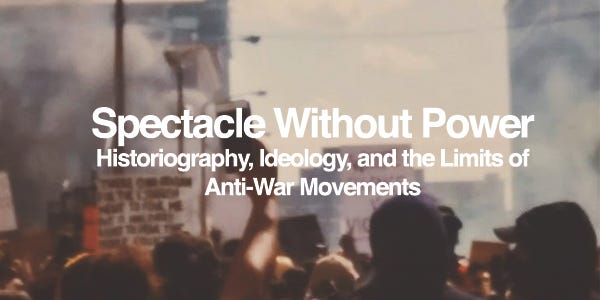
Morning Comrades.
The crisis presently confronting Western political “counter” culture is no longer reducible to a deficit of awareness, but must instead be understood as a crisis of efficacy grounded in the structural limits of political action within advanced capitalist societies. It is not that populations remain uninformed; rather, there is an increasingly widespread recognition that the acquisition and circulation of knowledge, however extensive, does not in itself translate into material transformation.
Over several decades, successive waves of protest, petition, and public demonstration have sedimented into what may be described as an archive of dissent that is symbolically rich yet strategically impoverished. These forms of political expression, while occasionally even articulating moral clarity and generating visibility, have demonstrated a persistent inability to alter the underlying trajectories of power. Whether in relation to climate mobilisation, anti-war activism, or broader social justice movements, one encounters a recurring pattern: the production of spectacle without corresponding leverage, the articulation of outrage without institutional consequence, and the attainment of visibility without structural change. What is now emerging from this condition is not merely apathy, but a more unstable and politically consequential sensibility, namely, the growing apprehension that the dominant repertoires of dissent are themselves circumscribed by the very system they seek to contest.
This impasse is neither accidental nor contingent, but reflects the historically specific configuration of power within the capitalist state and its associated ideological apparatuses. One may understand contemporary Western societies as characterised by a form of hegemony in which consent is organised not merely through coercion, but through the incorporation and management of dissent itself. In this framework, protest does not necessarily function as an external challenge to power; rather, it is frequently internalised as a permissible and even necessary component of the system’s own reproduction. The liberal-democratic state, far from being destabilised by dissent as such, often demonstrates a remarkable capacity to absorb, reframe, and neutralise oppositional energies, thereby preserving the fundamental relations of production and the class structures upon which they rest.
The subjective experience of this structural condition is one of tension and indeterminacy. As individuals and movements begin to perceive the limited efficacy of established political forms, a space of uncertainty emerges, one marked by a search for alternative modes of action that are frequently inchoate and politically underdeveloped. It is precisely within this space that institutional actors, political organisations, and mediating bodies intervene with particular effectiveness, the No Kings Org come to mind specifically in the current climate. By channelling diffuse discontent back into familiar and highly regulated processes, most notably electoral participation, they are able to transform potentially disruptive energies into forms that are both legible and manageable within the existing order. Elections are thus repeatedly framed as moments of existential significance, campaigns as sites of decisive intervention, and participation as an index of agency, even as the structural constraints governing policy and power remain largely unaltered. The cyclical pattern that results, wherein disillusionment gives rise to mobilisation, mobilisation to disappointment, and disappointment once again to managed forms of hope, can be understood as a key mechanism through which capitalist democracies reproduce their legitimacy. In this sense, the system does not require the absence of dissent; rather, it depends upon its continual renewal in forms that do not threaten its underlying foundations.
A further dimension of this problem lies in the historiography through which Western societies interpret their own traditions of resistance. The dominant narratives surrounding the anti-war movements of the twentieth century, for example in relation to the Vietnam War, are especially instructive in this regard. It is frequently asserted that mass protest within the United States and Western Europe exerted an influence on the termination of the conflict, such that public opinion, expressed through demonstrations, cultural production, and civil disobedience, is understood to have compelled the cessation of military intervention. This interpretation performs an important ideological function: it situates Western societies as ultimately self-correcting, capable of mobilising internal moral resources to restrain or reverse the excesses of their own state apparatuses. However, such an account risks obscuring the material determinants of the war’s outcome. The decisive factor in the defeat of the United States was not the transformation of opinion at the imperial centre, but the sustained and organised resistance at the periphery, most notably by the Viet Cong in conjunction with the North Vietnamese state.
To foreground this reality is not to deny that protest exerted any influence whatsoever; rather, it is to insist upon a more precise estimation of its role. Anti-war mobilisation may have contributed to shifts in the domestic political climate, may have imposed certain constraints upon strategic decision-making, and may have accelerated processes already underway within the state apparatus. Nevertheless, it did not constitute the primary determinant of the war’s conclusion. The conflict was brought to an end because it became materially and strategically untenable within the broader dynamics of imperialist competition and national liberation, not simply because it lost legitimacy within the societies prosecuting it. This distinction is of considerable theoretical and practical importance. Absent such clarity, contemporary movements risk overestimating their own capacity to effect change through symbolic or expressive means, while underestimating the structural conditions that delimit their action.
What emerges, therefore, is not a resolution but a deepening of the problem. If the dominant forms of protest are structurally constrained, and if prevailing historical narratives have tended to exaggerate their transformative power, then the question of political strategy must be reopened under far more exacting conditions. This entails a renewed engagement with the concepts of class struggle, state power, and the international division between core and periphery, as well as an examination of the organisational forms capable of mediating between consciousness and material force. The central difficulty lies in determining how political action might move beyond the level of symbolic resistance without being immediately reabsorbed into the circuits of hegemonic management that characterise contemporary capitalism. To pose this problem adequately is already to depart from the complacencies of liberal political thought; to resolve it, however provisionally, requires a level of theoretical clarity and organisational capacity that remains largely absent, which isn’t to say it is impossible to attain, on the contrary, but it remains a large chunk of the work to to be done.
This essay proceeds, therefore, from a position of impasse, treating it not as a paralysis to be lamented but as a condition to be analysed. Its aim is not to provide facile prescriptions, but to interrogate the structural limits of dissent in the contemporary West, to reassess the historical narratives that inform present understandings of political efficacy, and to explore the conditions under which forms of action capable of producing material change might emerge.
