
Freedom Fries
On Branding and Reality

Morning Comrades.
Capitalism has persuaded generations of people to understand the history of its violence through the language of freedom, so that the expansion of markets can be narrated as liberation, the destruction of foreign societies as self-determination, the seizure of resources as development, the overthrow of governments as democracy, the militarisation of entire regions as security, and the accumulation of extraordinary private fortunes as the natural consequence of individual liberty rather than the historical product of organised class power.
The word “freedom” itself has been made almost impossible to oppose because it has been emptied of the material content that might allow us to ask the only question that matters: freedom for whom, from what, and towards what material possibility? In the abstract, freedom is among the most defensible aspirations of human political life; in the historical vocabulary of the post-war West, however, it has become something considerably less innocent, a political brand through which the capitalist class has moralised its own interests and transformed the pursuit of accumulation into an apparently universal human cause.
What is presented as a civilisation organised around freedom has, in practice, been organised around the protection and expansion of property, capital accumulation, access to resources, control of labour, and the maintenance of a global hierarchy capable of guaranteeing these conditions, with freedom functioning less as the principle governing these relations than as the language through which those relations are rendered morally legitimate.
The distinction is essential because the mythology of the post-war West depends upon reversing cause and effect. We are taught that the West became wealthy because it was free, democratic and committed to individual rights, when the historical record presents something far more violent: the political institutions celebrated as the architecture of freedom developed within, and were materially sustained by, systems of colonial extraction, unequal exchange, imperial violence, racialised labour regimes, primitive accumulation and the continuous expansion of capitalist property relations.
The post-1945 order did not suddenly abandon this history; it reorganised and rebranded it. The old European empires became increasingly untenable in their formal colonial structures, but the underlying economic relationship between the wealthy industrial centres and much of the rest of the world was not abolished. It was reconstructed through finance, trade, multinational corporations, military alliances, development institutions, currency regimes, resource concessions, debt and political intervention, while the vocabulary changed from empire to development, from domination to partnership, from colonial administration to modernisation, and from imperial interest to the defence of the free world. The great ideological innovation was therefore not that the West ceased exercising power but that it increasingly learned to describe the exercise of that power as the defence of freedom itself.
The Second World War provides the decisive historical threshold because the United States emerged from the destruction of Europe with an extraordinary concentration of productive capacity, financial power and military capability, while the Soviet Union had demonstrated that an alternative political and economic system could survive the most devastating war in modern history and emerge with immense geopolitical influence. The resulting Cold War was consequently not merely a philosophical disagreement between freedom and tyranny, as the Western narrative would have it, but a struggle over the organisation of political economy, property, labour and international power. The United States and its allies understood very clearly that the preservation of a capitalist world economy required more than the domestic defence of private property; it required the construction of an international order in which capital could circulate, investment could be protected, resources could remain accessible, labour could be disciplined, and states threatening the existing distribution of economic power could be contained or removed. Freedom became the ideal vocabulary for this project because it allowed the defence of capitalism to appear as the defence of humanity itself.
This was the genius of the ideological construction as capitalism could now speak about itself without naming itself. Private property became freedom. Consumer choice was recast as freedom, just as the freedom to invest, the freedom of corporations to penetrate foreign markets and the freedom of capital to move across borders were progressively absorbed into the same ideological category, until the expansion of capitalist economic power itself could be presented as the expansion of human liberty. The freedom of employers to determine the conditions of production became economic liberty, while the collective freedom of workers to control production, redistribute wealth or abolish the private ownership of productive resources could be condemned as coercion. The contradiction was rarely acknowledged because the word had already been detached from material relations. Freedom therefore becomes not the absence of domination but the legal recognition of the right to participate in particular forms of domination.
The post-war Western settlement made this contradiction temporarily less visible because capitalism was capable, under exceptionally favourable historical conditions, of granting substantial social concessions without surrendering its underlying structure to a select few workers, unlike at any other time during its existence. The welfare state, strong trade unions, public services, rising wages, mass home ownership and relatively extensive social protections created a historical compromise in which large sections of the working class could experience genuine improvements in material life while capitalism continued to reproduce itself. This period became retrospectively mythologised as proof that the West had successfully reconciled capitalism and freedom, when in reality its stability depended upon a particular configuration of class power, productive expansion, organised labour and imperial privilege. The prosperity of the post-war decades was not simply the result of liberal values triumphing over authoritarianism; it was connected to the enormous productive expansion of the United States, the reconstruction of Europe, the privileged position of Western states within the international economy and the ability of capital to concede a larger share of social production without fundamentally altering who controlled its productive foundations.
More importantly, the social compromise was never universal. The freedom celebrated in Western capitals existed alongside colonial wars, racial apartheid, counter-insurgency and political repression across the Global South and at home. While Western governments presented themselves as guardians of a rules-based civilisation, they repeatedly supported dictatorships, coups and military regimes whenever democratic processes threatened established economic interests. Iran in 1953, Guatemala in 1954, the Congo in the early 1960s, Indonesia in 1965 and Chile in 1973 are not aberrations external to the history of Western freedom; they are part of the history through which that freedom acquired its geopolitical meaning. Governments could be overthrown when they nationalised resources, redistributed land, strengthened organised labour or attempted to exercise economic sovereignty, while authoritarian regimes could be embraced when they guaranteed investment, suppressed revolutionary movements and maintained favourable conditions for capital. The moral language remained constant: freedom, democracy, stability, civilisation. What changed was the identity of those who were permitted to possess these things.
This is why the history of the post-war West cannot be understood through its political rhetoric. One must examine the material interests beneath the rhetoric, because ideology becomes most powerful precisely when it teaches us not to look there. If a government nationalises an oil industry, the Western press may speak of authoritarianism and confiscation; if a multinational corporation acquires the same resources through legally protected investment structures, the language becomes efficiency, development and market freedom. If a socialist government expands public ownership, this is described as the restriction of economic liberty; if a corporation acquires public infrastructure and converts a social necessity into a revenue stream, the resulting process is described as liberalisation. If a population resists foreign military occupation, it may be described as extremism; if a Western military coalition intervenes thousands of miles from its own territory, it is described as the defence of international security. The moral vocabulary is therefore asymmetrical because its underlying political economy is asymmetrical.
The essential historical force is not freedom but accumulation and that means something more structurally significant: that the reproduction of Western power has historically been conditioned by the imperative to expand the material scale of capital.
Capitalism is not a system in which wealth merely happens to be produced; it is a social relation organised around the continuous expansion of value. Capital must circulate, accumulate and reproduce on an enlarged scale, and when existing markets, resources or labour arrangements become insufficient to sustain this expansion, capitalism generates pressures towards new markets, new territories, new technologies, new forms of extraction and new mechanisms of financialisation. The historical record of Western power becomes considerably less mysterious once this imperative is placed at its centre. Wars, alliances, sanctions, trade agreements, development programmes, infrastructure projects, financial institutions and military bases may differ enormously in their immediate political justifications, but they repeatedly intersect with the same material question: who controls the conditions under which wealth is produced and appropriated?
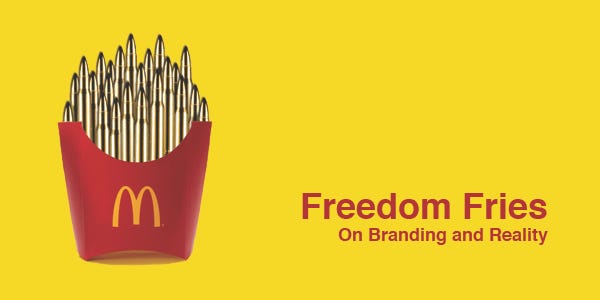
The most brutal consequence of the freedom narrative is therefore that it turns the victims of this process into obstacles to freedom. The population that stands in the way of an oil concession is rendered backward and the government that attempts to defend its economic sovereignty is recast as authoritarian. The worker who refuses the dispossession of their land becomes an impediment to development, and the person who resists privatisation is condemned as an obstacle to reform, while a country that refuses the geopolitical alignment demanded by Western powers is characterised as unstable, a population subjected to sanctions is reduced to collateral damage, and the civilian killed by an air strike becomes merely an unfortunate consequence of defending democracy. Freedom Fries now on Sale for 99cents.
In each case, the material violence disappears behind an abstraction, transformed by the language of Western power into something necessary, accidental or even benevolent, so that those subjected to its consequences are made to appear as the problem while the economic and political relations producing their dispossession are rendered almost entirely invisible.
The question is never allowed to remain, in its brutally simple form: what economic relationship is being defended, what property relation is being protected, and whose capacity to accumulate is being preserved?
The extraordinary thing is that the post-war Western order became increasingly dependent upon precisely this capacity to separate economic violence from visible violence. Direct colonial conquest became politically embarrassing, so economic domination could be presented through institutions apparently governed by neutral principles. The International Monetary Fund and World Bank could impose conditions upon indebted states while speaking the language of development and stability; corporations could extract value across borders while presenting themselves as engines of investment; financial markets could discipline governments without possessing the appearance of sovereign authority; sanctions could devastate civilian economies while being described as instruments of peace; and military intervention could be justified as humanitarianism even when the broader geopolitical architecture ensured that Western strategic and economic interests remained intact. The violence remain it just became institutional, administrative and increasingly abstract.
This abstraction is central to the Western conception of freedom because it permits an extraordinary moral inversion. The violence required to maintain an unequal economic order is rendered invisible precisely because it is distributed through institutions, contracts, markets, currencies and legal systems, while the violence that challenges that order is made hypervisible and presented as proof of barbarism.
Freedom, under these conditions, is not a principle but a hierarchy of permissions.
The Western obsession with defending freedom, the brand, is increasingly absurd. The more wealth is concentrated, the more aggressively the system insists upon the sanctity of individual freedom, because the language is required to conceal the fact that formally equal individuals possess radically unequal capacities to determine the conditions of collective existence.
A billionaire and a precarious worker may possess the same nominal freedom of expression, but one can purchase newspapers, platforms, political influence, lawyers, lobbyists and entire communications infrastructures while the other possesses little more than the legal right to speak into the void. They are equal before the law in the same way that two people standing before a supermarket are equally free to purchase food, despite one possessing a private fortune and the other possessing nothing.
The freedom offered by capitalism therefore increasingly resembles the freedom of the consumer confronted with a menu whose contents have already been determined by someone else and is unaffordable. One may choose between products, employers, political parties, platforms, lifestyles and subscription services, but one is rarely permitted to determine the social relations through which these choices become possible. The democratic question has been reduced from who controls production to what would you like to purchase? Politics becomes a marketplace, citizenship becomes consumption, and freedom becomes the ability to select among commodities produced within relations one had no role in determining.
The post-war transformation of the Western left into a politics increasingly concerned with preserving this consumerised conception of freedom has only intensified the contradiction. Much of liberal political culture has come to understand freedom primarily as protection from direct interference rather than as collective power over the material conditions of life. The result is a peculiar society in which people can theoretically say almost anything while possessing diminishing control over where they live, what they work for, how much they work, how their data is harvested, how their food is produced, how their energy is distributed, how their cities are organised and whether they can afford to remain in them. The individual is formally sovereign while materially subordinated. The political subject is celebrated precisely as the economic subject is rendered increasingly powerless.
And yet the system continues to call itself free and I am sick of it just as I am sick of their freedom fries.
It does so because the word has become a brand, and brands do not need to describe reality; they need to organise perception. Freedom functions in Western ideology much as a corporate logo functions in advertising: it is a condensed symbol through which a complicated and often violent material process acquires an emotionally attractive identity. Feel free to look into the Indonesian Sweat Shops that make Nike’s and connect the dots if that helps. The corporation does not need to prove that its product is good in every circumstance; it needs the consumer to associate the product with health, authenticity, independence or happiness. Likewise, the Western state does not need every historical action to have been genuinely emancipatory; it needs the broader image of freedom to remain sufficiently powerful that violence committed in its name can be interpreted as an unfortunate contradiction rather than a structural feature.
The brand survives through repetition. Freedom is invoked whenever capital requires legitimacy. It was invoked against communism, against national liberation movements, against socialist governments, against anti-colonial struggles, against organised labour and against any state attempting to place substantial economic resources outside the control of Western capital. It is invoked today in the defence of markets, private property, financial mobility, intellectual property, corporate power and geopolitical alliances. The vocabulary changes around it, but the underlying function remains remarkably stable: freedom is the moral language through which existing relations of property are represented as universal interests.
This is why the historical question cannot be whether the West believes in freedom, which it most definitely does not. The more useful question is what the West has historically been willing to do in order to protect wealth. Once asked in those terms, the record becomes difficult to misunderstand. The wars, coups, occupations, sanctions, colonial administrations, debt regimes, resource struggles, corporate interventions and military alliances cease to appear as disconnected episodes in an otherwise noble history and instead begin to reveal a recurrent pattern in which political power is mobilised to protect the conditions of accumulation. Sometimes the motive is direct profit; sometimes strategic control; sometimes the preservation of a broader economic order whose benefits are distributed through complex institutional structures. But the underlying imperative remains: the economic system must continue reproducing itself.
This is where the emptiness of the Western conception of freedom becomes impossible to evade. If freedom means only the absence of formal legal prohibition, then the person with no economic security is free to starve, the worker is free to accept whatever employment the market offers, the tenant is free to pay whatever rent the landlord demands, the indebted country is free to accept the conditions imposed upon it, and the population whose resources are coveted by foreign capital is free to accept incorporation into the global market on terms established elsewhere. Such freedom is not emancipation. It is the juridical description of a world in which the most important decisions have already been made.
Freedom was never the organising principle of the Western order. It was the language through which that order learned to speak about itself without admitting what it was doing. The organising principle was the reproduction and expansion of a particular mode of production, and where necessary its protection through political, economic and military power. Freedom became the advertisement, democracy became the packaging and human rights became the moral vocabulary. Beneath the language was the same material imperative: accumulate, expand, protect property, secure resources, discipline labour, open markets and prevent any alternative social arrangement from acquiring sufficient power to interrupt the process.
Once freedom is understood in those terms, the mythology becomes much harder to sustain. The West did not spend the last eighty years defending freedom. It spent them defending a particular organisation of wealth and power, and freedom was the name repeatedly placed upon that defence. The historical task before us is therefore not to ask how to make capitalism more faithful to freedom, because that reverses the relationship between the two. It is to ask what freedom would mean once wealth ceased to be the supreme organising principle of society. Only then does the word begin to recover any meaning beyond the logo under which the capitalist class has sold its violence to the world.
Yours, warmly,
V.
It was never freedom, always subjection, bondage, restraint, captivity, slavery, and exploitation, with a great big side of cruelty to help the ‘freedom’ go down.
Thank you, excellent piece, definitely to reread and share!