
Anomie
Societal Collapse and the Ruins of the West

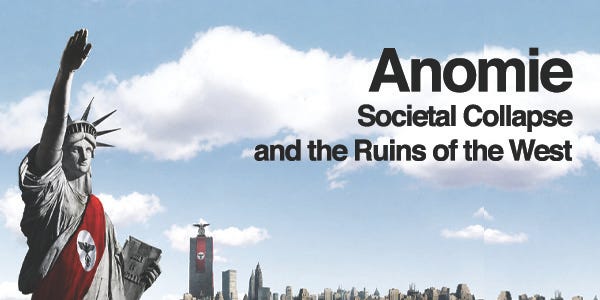
Morning Comrades.
I wrote most of this in my notes app at around 530am in the morning whilst pretending to get some sleep during this heat wave and whilst I have done my best to edit it, and check for spelling mistakes, please be gracious with me, especially if I waffled, my brain is literally a little more fried than usual of late and truthfully elsewhere, but that shall pass, also, and soon.
Contextually, this essay stems from the news that I am sure most of us got the other night from the US, when on June 23, eight individuals were sentenced to a combined 450 years in federal prison for a July 4, 2025, attack on the Prairieland ICE Detention Center in Alvarado, Texas. Prosecutors identified the group as an "antifa cell" - genuinely nothing but bullshit and a bogus trial to set an example. As we are well into the 4th Reich and Fascism is in full effect, this in itself doesn’t come as a surprise but it had me thinking why so many of us continue to believe that we exist in the fairytale out grandparents and parents told us we all would grow up in. They, especially if they were white and ideally not working class, believed and conditioned us so, that we live in an equitable, fair and democratic society, which, was horseshit back then as much as it is today. Nevertheless, we still predominately act as if that charade was in play, when in reality the ruling class around the West have long decided to move on and create a new reality and mostly, we haven’t caught up yet. That led me to the idea / school of societal decay and what it looks like, outside of the horseshit Hollywood propaganda we call films and TV I guess, which much of the below is about. None of of which that constituted the Horror Show our parents taught us about “the free world” exists, there is only power and the struggle over it now that our respective ruling classes have decided to switch channels. Once we understand that, we can adjust our strategies accordingly and stop wasting our time with some feigned shocked content creation and individual brand building that masquerades as activism.
The concept of anomie emerged within the work of Émile Durkheim as an attempt to grasp those historical moments in which the institutions, values, expectations, and symbolic structures that ordinarily organise social existence cease to command either confidence or legitimacy, thereby producing not simply dissatisfaction or instability but a more profound condition of social disorientation in which individuals continue to inhabit a society whose formal structures remain operational even as the moral and ideological foundations that once animated them steadily dissolve. What makes the concept particularly valuable for understanding processes of social collapse is that societies rarely disintegrate first at the level of their visible infrastructure, for roads may continue to be maintained, elections may continue to be held, commodities may continue to circulate, and bureaucracies may continue to function long after the collective beliefs that rendered such activities meaningful have entered a state of irreversible decline. Indeed, collapse is often less a matter of institutions ceasing to exist than of institutions continuing to exist after the reasons for believing in them have disappeared, such that the outward appearance of social order increasingly conceals an underlying erosion of legitimacy, coherence, and purpose.
If this concept acquires a particular urgency in the contemporary conjuncture, it is because the societies of the capitalist core increasingly exhibit precisely the characteristics Durkheim sought to describe, albeit in forms whose causes and consequences extend far beyond the explanatory limits of classical sociology. Across Europe and North America one encounters populations that continue to participate in the rituals of liberal democratic society while simultaneously displaying an unprecedented scepticism towards the institutions through which that society claims to govern itself, a contradiction which manifests not merely in declining trust in governments, parties, media organisations, corporations, and public authorities, but in a more diffuse sense that the future promised by the post-war order has become inaccessible, if not entirely fictitious. Individuals are encouraged to pursue educational credentials whose economic value steadily diminishes, instructed to work harder within labour markets that offer declining security, urged to participate in democratic processes whose capacity to shape material outcomes are increasingly constrained by forces beyond public control, and encouraged to imagine futures whose social, ecological, and economic foundations visibly deteriorate with each passing year. Consequently, what emerges is not merely disappointment with particular institutions but a growing inability to reconcile official narratives with lived experience, producing precisely the sort of normative disintegration that Durkheim identified as characteristic of anomic conditions.
Yet to understand the contemporary significance of anomie requires moving beyond Durkheim’s framework, not because his observations were incorrect but because the historical forces generating contemporary social fragmentation cannot be adequately explained through the language of moral regulation alone. What appears sociologically as normlessness appears, from the standpoint of historical materialism, as the subjective experience of objective contradiction, for the erosion of social meaning does not occur independently of economic structures but rather emerges from a system whose capacity to reproduce the material and ideological conditions of its own legitimacy has entered a prolonged and increasingly visible crisis. Anomie, in other words, is not merely a cultural phenomenon superimposed upon an otherwise functional economic order; rather, it constitutes the lived experience of a mode of production that can no longer deliver the promises through which it historically secured consent, and which consequently finds itself compelled to govern through increasingly transparent forms of coercion, spectacle, and managed resignation.
What distinguishes the present moment from previous periods of capitalist instability is not the existence of crisis itself, since capitalism has always advanced through cycles of destruction and reconstruction, but rather the growing inability of its dominant institutions to convert crisis into renewed legitimacy. Throughout much of the twentieth century, particularly within the metropolitan centres of the capitalist world-system, economic expansion enabled ruling classes to present exploitation as opportunity, hierarchy as meritocracy, and imperial accumulation as national prosperity. The violence required to sustain these narratives was neither absent nor concealed, yet it remained geographically displaced, exported to colonies, semi-colonies, indebted peripheries, and sacrificial zones whose populations experienced directly the instability, dispossession, and social fragmentation that the inhabitants of the imperial core were encouraged to regard as aberrations rather than structural necessities. The apparent coherence of Western society therefore rested not upon the transcendence of capitalism’s contradictions but upon their externalisation, such that social peace at the centre depended upon forms of extraction and domination whose consequences were disproportionately borne elsewhere.
